What Is a Yunomi? The Japanese Tea Cup Built for Daily Use and Deeper Connection
The yunomi isn't precious. It's designed to be held, used, and part of your day. A ceramicist on why the humblest cup in the collection might be the most important one.
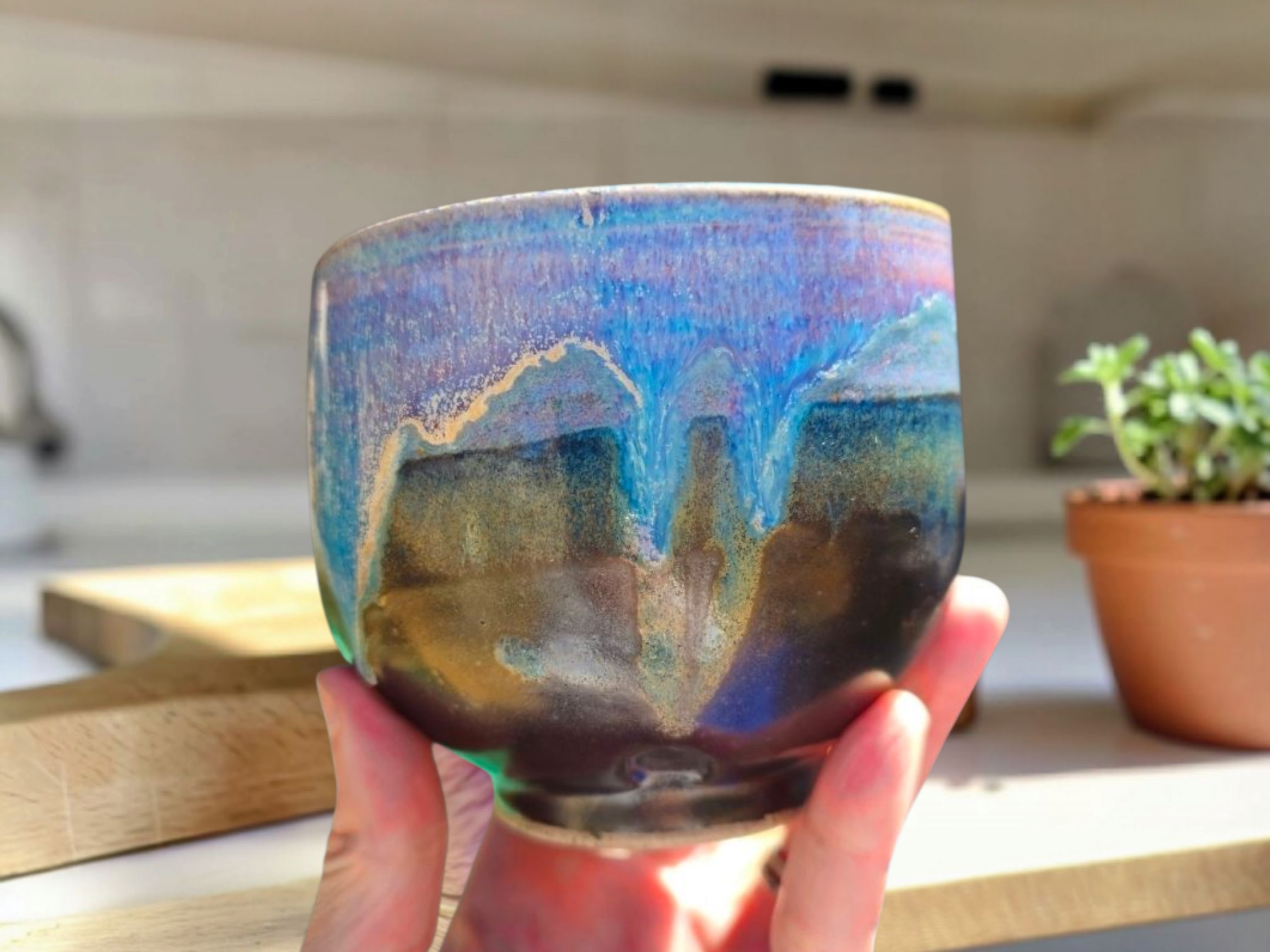
There's something quietly magical about an everyday cup. Not the flashy, one-of-a-kind, "look-at-me" piece that sits on a shelf, admired from afar, but the humble, footed yunomi, a Japanese tea cup meant for daily use. It's in these little rituals, these small moments of pause, that a cup truly becomes alive.
The cup pictured is a soda-fired yunomi from Lin Kensington's "You Know Me" series.
What Is a Yunomi?
A yunomi (湯呑み) is a traditional Japanese tea cup, typically cylindrical or slightly tapered, with a foot ring and no handle. Unlike a chawan, the wide, open bowl used in formal tea ceremony. The yunomi is designed for everyday drinking. It's the cup you reach for in the morning. The one you wrap both hands around on a cold afternoon. The one that earns its place through use, not display.
Yunomi are almost always made of stoneware or porcelain, fired at high temperatures for durability. The form is deceptively simple but in a skilled potter's hands, that simplicity becomes a canvas for everything: the glaze, the texture, the subtle irregularities that make each piece unmistakably handmade.
Built for the Hand
What I love about the yunomi is that it's approachable. It's not precious. It's designed to be held, to be used, to be part of your day. The foot ring lifts the cup slightly, giving it presence without pretension. The rim, often undulating and imperfect, invites your lips. The weight, slightly heavier than a mass-produced cup reminds you that someone made this.
And that's exactly why it's having a moment right now. In a world where we're often moving too fast, where objects are mass-produced and disposable, a handmade yunomi asks you to slow down. To notice. To connect.
The "You Know Me" Series
I make a series I call You Know Me : Yes, exactly like "you know me," the phrase. It's a playful nod to what happens when you pick up one of these cups: you are literally getting to know me.
You get to explore the surfaces. Trace the tiny impressions where my fingers pressed. See where the clay stretched and pulled, where the glaze settled just so. Every cup carries that evidence. The foot, thoughtfully formed, gives balance and presence. The rim, undulating and imperfect, tells you this was made by a human being in a specific moment, not stamped out of a mold.
Buying a You Know Me cup isn't just about acquiring a piece of pottery. It's about entering a conversation. You, the collector, are invited to learn, to touch, to observe, to participate. And I, as the maker, get to share a little piece of my world with you.
What to Look for in a Yunomi
The foot ring. Turn the cup over. A well-trimmed foot ring should feel deliberate not an afterthought. It lifts the cup off the table and gives the whole form a sense of intention.
The rim. Run your finger along the lip. In a handmade yunomi, the rim will have slight variation, a gentle undulation that makes contact with your mouth feel natural rather than uniform.
The glaze break. Where the glaze thins or pools, at the rim, around textured areas, near the foot , that's where the firing reveals itself. Look for depth and movement rather than flat, even coverage.
The weight in your hand. A yunomi should feel substantial but not heavy. Hold it empty, then imagine it full of tea. It should feel balanced, comfortable, like it belongs in your hand.
Why Collectors Are Paying Attention
The yunomi sits at an interesting intersection for collectors: it's functional enough to use daily, but specific enough in form and tradition to reward serious attention. A well-made yunomi by a skilled potter can run $80–$300, sometimes more for established artists, prices that reflect the time, material, and skill involved, but still accessible compared to larger statement pieces.
More importantly, a yunomi is the kind of object that improves with use. The glaze develops a subtle patina. The cup becomes yours in a way a shelf piece never can.
Pour Your Tea
By using this cup, you're exploring the artist's mind through their hands. You're seeing thoughtfulness in every curve, every nuance of glaze, every moment where care met clay. And if the potter did their job right, you start to feel a little like you know them.
So pour your tea. Feel the weight. Trace the rim. Notice the foot. Take a moment. Because in this small, everyday object, there's a little story, a little connection, a little ritual waiting to happen. And isn't that exactly the kind of thing we all need a bit more of?
Enjoying this?
Get articles like this weekly.
Continue Reading

Soda Firing: What It Is, How It Works, and Why Collectors Are Paying Attention
A collector's guide to one of ceramics' most unpredictable — and rewarding — firing techniques. The kiln becomes the collaborator.
Ceramics IQ
Shino: The Glaze That Never Fires the Same Way Twice
A feldspar-based glaze with roots in 16th-century Japan, Shino is prized for its unpredictable surface textures, dramatic color range, and the simple fact that no two firings ever look the same.
Ceramics IQ